

I Know About Shadow Already

When Metanoia Becomes Revelation, Part 2
A man says, “I am the Daddy. I have two children and a wife who refuses to work.”
A woman says, “My father is impossible to talk to. He only wants to argue and prove his point.”
Someone else says, “My partner is a spendthrift. She does not know how to plan for a rainy day.”
These are ordinary relationship complaints, the kind of things people say every day about spouses, parents, children, siblings, friends, bosses, and co-workers. On the surface, they appear to be about responsibility, communication, money, fairness, maturity, or common sense — and sometimes they are. But from a Jungian perspective, the complaint may also be the beginning of a profound revelation if we are willing to do shadow work. The thing we keep saying about the other person may be pointing toward something we have not yet recognized in ourselves.
The man who feels burdened by everyone else’s dependence may also need to ask where he has become identified with being the only responsible one. The daughter who suffers under her father’s need to argue may need to ask where she too is secretly rigid, defensive, or determined to prove her own point. The partner who condemns the spendthrift may need to ask whether caution, fear, and control have taken over so completely that pleasure, trust, and spontaneity now have to appear through someone else. Jung says, opposites are forever seeking each other out.
“It has become abundantly clear to me that life can flow forward only along the path of the gradient. But there is no energy unless there is a tension of opposites; hence it is necessary to discover the opposite to the attitude of the conscious mind.” — Carl Jung,Two Essays on Analytical Psychology, par 78
This is why relationship is such a powerful vessel for shadow work. We are accustomed to focusing on the other person: what they are doing, what they are not doing, how they make us feel, and why they will not change. We analyze their behavior, interpret their motives, rehearse conversations in our minds, as we try to understand what is happening between us. But something far more complex and profound is also taking place in both people. A relationship is not only an encounter between two personalities. It is also an encounter between two unconscious psyches, each carrying its own history, complexes, wounds, defenses, longings, and unlived life.
Relationships are never random.
Whatever fascinates us, disturbs us, draws us in, repels us, enrages us, or keeps us emotionally bound is usually pointing toward something in the psyche that is seeking awareness. Yet, we rarely see it that way until much later. At first, we see it as belonging to the other person. It is their intensity or power games, his coldness or betrayal, her neediness, or refusal to love in the way we long to be loved. And sometimes that is true. People do wound each other. They do betray, lie, manipulate, humiliate, seduce then disappear, or abandon. Shadow work does not mean we are to deny what has happened outwardly. It means we also ask what has been activated inwardly from these experiences.
This is where astrology becomes so valuable. A birth chart does not tell us that something is wrong with us, nor does it excuse hurtful behavior in another person. It reveals the symbolic pattern of each psyche and shows where certain archetypal energies are likely to be constellated through relationship. Before we know how to hold these energies consciously within ourselves, we often experience them through our projections onto each other, usually through extremes. Astrology gives us a symbolic language for seeing what we could not see before. It does not remove responsibility, but it gives us a more compassionate and precise way to take responsibility for our own lives.
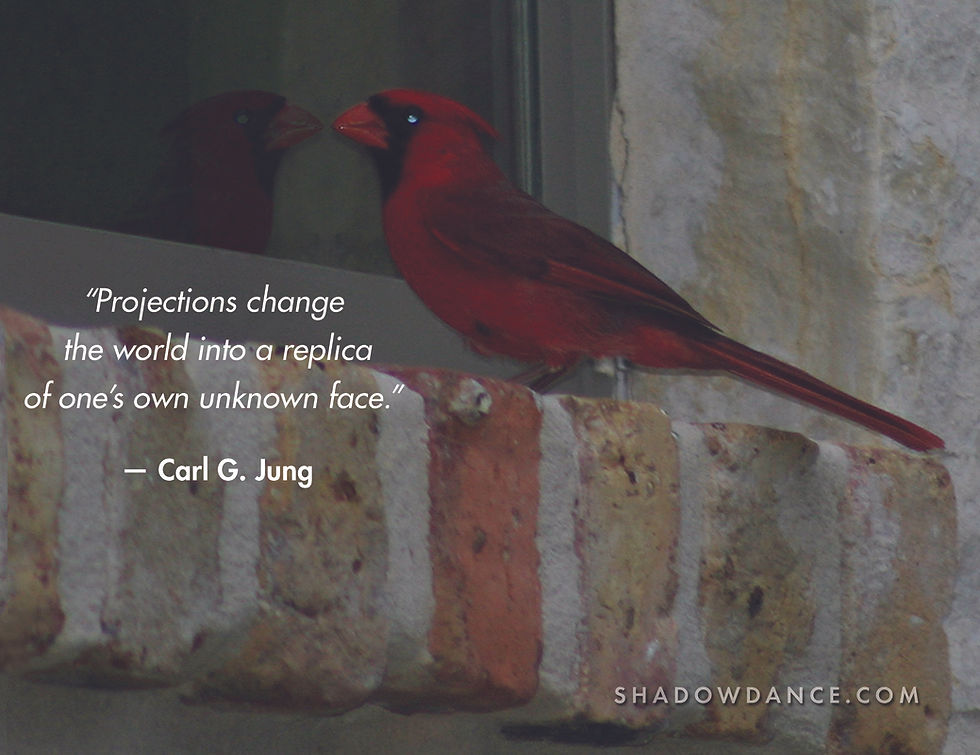
Many people think knowing the word “shadow” means they have met their shadow. But the shadow is not a concept — it is living psychic substance. It possesses us unconsciously, hooks us emotionally, and evokes reactions that are disproportionate to the actual event. These shadow complexes keep us bound to the very people we say we want to be free from. We may understand the idea intellectually and still be caught in the same longings, resentments, fears of abandonment — in short compulsions — as compulsions are one of those mysteries of life that vex us. This is why shadow work must become a lived practice. We have to stop long enough to ask, “Why does this person have so much power over me?” and “What part of myself am I meeting through this relationship?”
If a man says, “I am the Daddy. I have two children and a wife who refuses to work,” the question is not only, “Why am I carrying everyone?” He may truly be overburdened and resentful. But through metanoia, the question becomes, “Where have I become identified with being the only responsible adult?” “Where do I secretly need to be needed?” The revelation is not that his burden is unreal, but that the role itself may have become part of his identity.
If a woman says, “He always disappears when things get difficult,” the question is not only, “Why does he run away?” He may truly avoid intimacy, conflict, or emotional responsibility. But through metanoia, the question becomes, “Where do I leave myself when things become painful?” “Where do I abandon my own center while chasing the unavailable other?” The revelation is not that abandonment does not hurt, but that the pain may be calling her back to the part of herself she once had to abandon.
If someone says, “My partner is a spendthrift. She does not know how to plan for a rainy day,” the question is not only, “Why is she so irresponsible?” There may truly be practical issues that need honest discussion and clear agreements. But through metanoia, the question becomes, “Where have I become so identified with caution that I have lost trust?” “Where has fear of the future taken over my capacity for pleasure?” The revelation is not that money does not matter, but that money may be carrying a deeper conflict between fear and trust.
“Seen from the one-sided point of view of the conscious attitude, the shadow is an inferior component of the personality and is consequently repressed through intensive resistance. But the repressed content must be made conscious so as to produce a tension of opposites, without which no forward movement is possible.The conscious mind is on top, the shadow underneath, and just as high always longs for low and hot for cold, so all consciousness, perhaps without being aware of it, seeks its unconscious opposite, lacking which it is doomed to stagnation, congestion, and ossification. Life is born only of the spark of opposites.” — Carl Jung, Two Essays on Analytical Psychology, par 78
This is why relationship has been one of my greatest teachers. Again and again, it has revealed some part of myself I had not yet fully seen. As I have come to accept the teleology of existence — the sense that the unconscious is always leading us somewhere — I have learned that whatever I have not yet embraced as part of myself may first appear as fascination. Fascination is not something we easily walk away from. It can feel as if we are out of control because an archetypal energy has been constellated. The transits of the planets do not simply “do something to us.” They operate through us, awakening psychic material that wants to become conscious. More recently, during the transit of Pluto square my Venus, another mirror-image revelation appeared. At first, it was tempting to say, “The uneasiness I am feeling is about him.” That is almost always where we begin, because the other person seems to be the source of the confusion, the pain, the anger, or the longing. Pluto transits often show observable Plutonian experiences: obsession, power struggles, compulsive reactions, fear of loss, betrayal, and motives that are far more complex than we want to admit. But Pluto moves slowly, and it takes time to understand the deeper dynamic being revealed. In my own case, I had to see a distinct fear of repeating a pattern I had experienced in my 30s when Pluto conjuncted my Venus. In time, I saw that he was showing me the mirror of my still-buried vulnerability, as well as my own secretiveness, which I had been projecting onto him.
When we do shadow work we are offered a path toward self-knowledge; a path toward integration, and a more whole way of being. But this path requires something that is not often emphasized in our culture. What we are being asked to do is change our worldview and recognize what the Alchemists knew way back then — that what is inside is always outside. This is the ancient wisdom expressed in the phrase: “As above, so below; as within, so without.” We have to be willing to see through ourselves.
Metanoia is not about changing the other. It is about changing the way we see each other.
What once felt like conflict can begin to reveal meaning. What once felt like rejection can begin to reveal our own unlived potential, and this is where taking responsibility becomes the turning point. Not responsibility as blame or shame, but responsibility as the ability to respond consciously to what has been constellated within us. Once I could see that we were both projecting Pluto onto each other, the relationship became an opportunity to recognize what needed to change in me.
This does not mean the work is easy, and it does not mean every relationship can or should continue. But when consciousness is gained, the encounter has served a purpose. Sometimes the purpose of the relationship is not permanence. Sometimes the purpose is the revelation of what the Self wanted from us through this experience. It may be something we were missing: a disowned part of ourselves we had projected, judged, or been repulsed by, and that could leave us more whole than when it found us.
When we are willing to ask what the other person is revealing in us, relationship becomes more than personal drama. It becomes an alchemical vessel for metanoia, a change of mind, a change of heart, and ultimately, a change in the level of consciousness from which we live our lives.
A note for new readers: Words such as shadow, projection, individuation, and the Self come from Jung’s psychology. I have made a Jungian vocabulary guide called Dictionary of Terms available for free on my website. It also appears in my latest book, When the Other Is You: Love Beyond Projection — The Alchemy of Relationship in the Age of Aquarius.
I’m delighted to share my conversation with Robin Fisher Roffer on Plenty of Husbands Podcast. We talked about relationship, projection, shadow work, astrology, and the journey of becoming conscious through love. Thank you, Robin, for this beautiful conversation. 🎧 Listen on Spotify🎧 Listen on Apple Podcasts and visit her website: PlentyofHusbands.com
If this post resonates, the work is not to change what is outside of you, but to become more conscious of what is within. This is the foundation of the work I do with individuals and couples — using both Jungian psychological insight and astrology as a way of making the unconscious visible. More information can be found at shadowdance.com.
A Testimonial for Consultations & Shadow Work Coaching
“Working with Rebeca Eigen over the last five months has been one of the most transformative experiences of my life. Through her deep understanding of Jungian psychology, astrology, shadow work, and relationship dynamics, she has helped me navigate one of the most painful and challenging periods I have ever faced.
What makes Rebeca extraordinary is the way she combines profound insight with honesty, vulnerability, and humor. Our long-term work together has helped me understand myself more deeply than years of traditional talk therapy ever had. Through exploring my chart, my shadow, and my marriage, I gained clarity, compassion, and a completely new perspective on myself, my partner, and the opportunities for growth within relationship.” — Lisa Hilas, Vacaville, CA


Comments