

The Fire of Desire Meets the Waters of the Soul

Venus in Aries under the influence of Saturn and Neptune

First published in my Substack on April 21, 2026
When Venus is in Aries — or when Aries is on the cusp of the 7th house in the natal chart — the approach to love begins as something instinctive, immediate, and alive. This can also apply to those with strong aspects between Venus and Mars, as they are tied together through rulership. There is a natural courage here, a willingness to pursue what is desired, to move toward connection without hesitation. When these Aries placements are in the natal chart, attraction is felt quickly, expressed directly, and often acted upon without overthinking. There is something very honest about it, something real — but also something unfinished. Because while people with these configurations know how to begin, unless there are stronger aspects to ground them, they don’t always know how to stay.
When Saturn transits Venus in Aries, the experience of love begins to change. What once felt effortless may now feel slowed down, resisted, or tested. Relationships may require more than chemistry. They begin to ask for consistency, accountability, collaboration and a willingness to remain present when the initial sparks fade. For someone used to following desire, this can feel frustrating at first. It may at times even feel like rejection. But Saturn is not denying love — it is asking whether love can become something real.
Independence, which once operated as a kind of reflex, is now brought into a focused awareness. Many people discover that what they called independence was actually a form of protection or a way of leaving before being left, because we are all vulnerable when we begin a relationship. Saturn gently but firmly removes that option when it comes around by transit. It asks a different question: Can you remain in relationship without losing yourself — and without needing to pull away to prove that you haven’t? And perhaps an even deeper one: Can you stay present when you feel the urge to leave?
This is not an easy shift. It requires learning how to express desire without defensiveness, how to stay through discomfort, and how to take responsibility for the choices we make in love. The emphasis moves from impulse to intention, and from attraction to commitment. In that movement, something inside us begins to mature. We begin to develop a love that can actually last. Love is no longer something that just happens to us. It becomes something we participate in — consciously and deliberately. We begin to allow it to stretch us, from the initial excitement into a deeper, more conscious commitment.
Neptune introduces a different kind of challenge. Instead of limitation, it brings ambiguity. Instead of structure, it brings openness. For Venus in Aries, which prefers to know what it wants and move toward it, this can feel disorienting. There may be moments of questioning: Is this real? Am I seeing clearly? Or am I projecting something onto the other person that I want to happen? This can feel like a dream come true, but it can also be confusing. Without awareness, Neptune can lead to idealization — to seeing what we want to see rather than what is actually there. It can create a tendency to give too much, to sacrifice oneself for the sake of connection, or to become entangled in relationships that are undefined or unavailable. But Neptune is not here to deceive. It is here to deepen perception. It asks whether we can remain open, sensitive, and compassionate — without abandoning ourselves in the process.
Where Saturn grounds and defines, Neptune dissolves and softens. When Neptune is also transiting Venus in Aries, the clarity of desire can become less certain. What once felt direct may now feel elusive. There can be a sense of being drawn toward something intangible — an ideal, a feeling, a possibility that is difficult to name. Taken together, Saturn and Neptune create a powerful dynamic around Venus in Aries. One demands reality. The other invites imagination. One brings form while the other dissolves it at the same time and in the tension between them, something essential is revealed about how we love.
This is where the deeper work begins.
We begin to see that desire alone is not enough, but neither is structure without feeling. We need both — the capacity to remain present and grounded, and the ability to feel deeply without losing clarity. We are invited into a different kind of relationship, not in the initial attraction, but in what follows.
For those with Venus in Aries, this period can feel like a turning point. The way love has been approached in the past may no longer work. Old patterns — of pursuing, withdrawing, idealizing, or reacting — begin to fall away. Not all at once, but gradually, through moments of disappointment, realization, and insight. Venus in all of us wants to love and be loved, but self-esteem is not built on illusions. It is built through the quiet, consistent act of living in alignment with what we know to be true, and nowhere is that more visible — or more challenging — than in the way we love.
And what is being asked is this: Can you love in a way that includes both yourself and the other? Can you remain true to your own desires while also being accountable for how those desires are lived out in relationship? Can you see clearly, feel deeply, and act with integrity — even when it would be easier not to? This is where fate and free will meet. The archetypal pattern is activated — that part is not optional. But how we respond to it is. We can resist, repeat, and remain unconscious of what is being asked, or we can engage with it, slowly, consciously, and allow something new to emerge.
For those who are single, attraction may take on a dreamlike quality, infused with longing and imagination, as Neptune transits often open the heart — but without clear boundaries. There is often a sense of searching — for something, or someone, that feels just out of reach. What is longed for is not only another person, but something deeper that we can’t quite name.
For those who are in relationship, the path becomes more defined, but also more demanding. The opportunity is no longer to seek the ideal in the outer world, but to recognize that what is being sought is not actually in the other person. From a Jungian perspective, love is not something we find in each other and then possess. What we fall in love with initially is often projection of our own unconscious contents. Idealization and projection are initially mixed with shadow — the Anima or Animus constellated in the other. That experience is real, powerful, and often overwhelming, but it is only the beginning.
The deeper invitation happens when we withdraw those projections, not to diminish love, but to make it real. What we are actually longing for is not the person alone, but the experience of something greater that emerges through the relationship. The soul is not something we find — it is forged through the encounter between the conscious personality and the unconscious Self. Jung described the Self as the divine aspect of the psyche seeking expression through our lives. In relationship, this does not happen automatically. It requires two people who are willing to see through themselves, to do shadow work and take back what they have projected and expected each other to carry. Without that part of the process the Alchemists say we short circuit and start over with someone else, but that would be first half of life consciousness repeating itself over and over.
Saturn invites us to remain present in the tension between who the other person actually is and who we imagined them to be. It grounds the relationship in reality, in commitment, and in shared responsibility. Neptune, on the other hand, opens the heart to something beyond personal ego needs — to compassion, to meaning, and to the experience of a connection that feels larger than the two individuals involved. Without Saturn, Neptune becomes illusion. Without Neptune, Saturn becomes lifeless structure. Together, they ask for a love that is both real and inspired, both grounded and open.
This is where the true meeting point of fate and free will is found. We do not choose the archetypal patterns that are activated within us — that is the realm of fate. But we do choose how we meet them. We can react, repeat, and remain unconscious of what is being asked or we can recognize what we are learning about ourselves through the mirror they represent and allow even the ending of a relationship to change us. In that way, each experience becomes part of a larger process, showing us something we could not have seen alone.
Edward F. Edinger describes this process beautifully in his Mysterium Lectures: “Sooner or later, if psychic development is to proceed, that split-off shadow figure must be encountered as an inner reality; then one is confronted with the problem of bringing the opposites together as opposed to separating them. Separating the opposites is a task for the early part of life, and the union of opposites is the task for the later part of life.”
This is exactly what we encounter in relationship. At first, we separate — we define ourselves, assert our independence, and discover who we are. Over time, if we stay, we are asked to do something more difficult: to hold the tension of opposites and allow something new to emerge. We have to meet ourselves first before we can meet another consciously. We are here to create more and more consciousness — and that, in the end, must be its own reward.
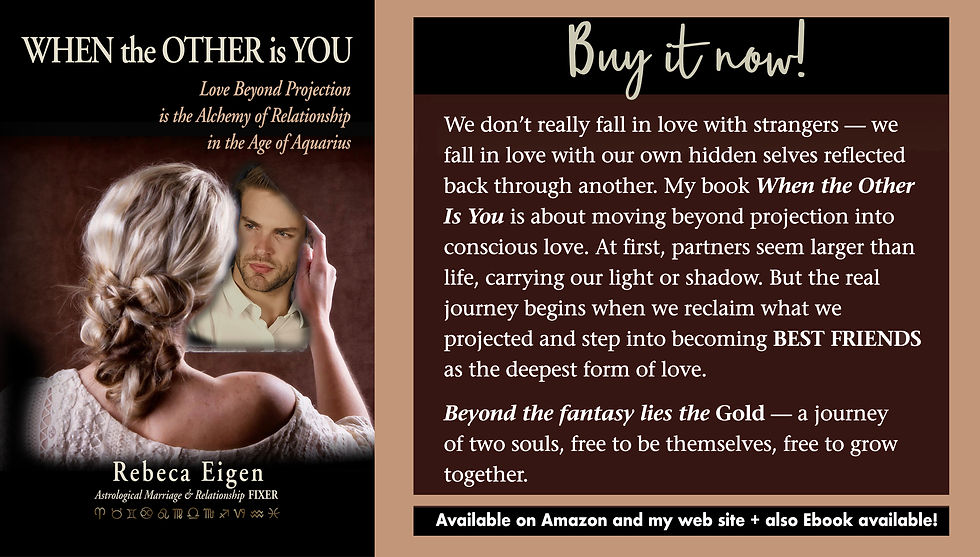
- A REVIEW FOR WHEN THE OTHER IS YOU - One of my favorite “big thoughts” lately is about how much we need books about the astrologically-examined life. That’s what happens when wise people share what happens when they actually USE modern psychologically-sophisticated astrology to deepen their own experience and speed their evolutionary path. If you’e interested in going beyond yet another astrology textbook and seeing what the future of our craft looks like, try WHEN THE OTHER IS YOU.”
— Astrologer and Author, Steven Forrest


Comments